

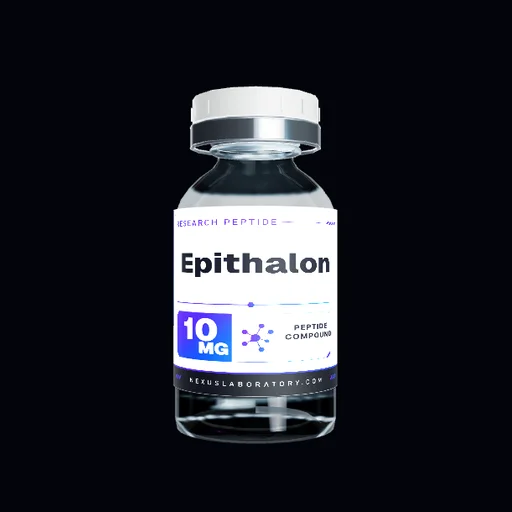
For in-vitro research use only. Not for human consumption.
Epithalon
Epithalon (Epitalon) is a synthetic tetrapeptide analog of epithalamin, a naturally occurring pineal gland peptide. Research investigates its ability to activate telomerase (hTERT), the enzyme responsible for maintaining telomere length. It is also studied for its effects on melatonin synthesis and circadian rhythm signaling.
Epithalon definition
Epithalon (Epitalon) is a synthetic tetrapeptide analog of epithalamin, a naturally occurring pineal gland peptide. Research investigates its ability to activate telomerase (hTERT), the enzyme responsible for maintaining telomere length. It is also studied for its effects on melatonin synthesis and circadian rhythm signaling.
No sequence is listed in the current catalog record for this product.
- CAS
- 307297-39-8
- MW
- 390.35 g/mol
- Sequence
- Not listed
- Half-life
- Not listed
- Formula
- C14H22N4O9
- Purity
- 99.73%
- Form
- Lyophilized powder
- Class
- Pineal Peptide / Telomerase Research Compound
Reconstitution calculator
Estimate vial concentration and aliquot volume from the selected vial mass, solvent volume, and target research amount.
Calculations are for lab planning only and do not replace the product COA, protocol requirements, or qualified professional review. Confirm solvent compatibility before use.
Compound details.
- CAS Number
- 307297-39-8
- Molecular Weight
- 390.35 g/mol
- Molecular Formula
- C₁₄H₂₂N₄O₉
- Class
- Pineal Peptide / Telomerase Research Compound
- Purity
- ≥99% purity
- Physical Form
- Lyophilized powder
- Storage
- Store at -20°C (long term). Refrigerate after reconstitution.
Research context.
Developed by Prof. Vladimir Khavinson at the Saint Petersburg Institute of Bioregulation and Gerontology. Published studies in Bulletin of Experimental Biology and Medicine and Neuroendocrinology Letters have examined its effects on telomerase activation and bioregulatory peptide signaling.
Verification standard.
Every Nexus Laboratory batch ships with a Certificate of Analysis documenting HPLC purity (target ≥98%), mass spectrometry identity (expected versus observed mass), and endotoxin screening — verified by third-party laboratory testing and publicly archived. Review Nexus lab verification.
Epithalon is part of the Nexus Longevity & Cellular Health catalog. Mitochondrial, senolytic, and cellular health research compounds. Each listed variant is priced from the consolidated Nexus catalog and intended for qualified research use only.
TODO-COPY: replace with real compound-specific narrative.
The chemistry.
4-amino acid peptide (Ala-Glu-Asp-Gly), synthetic analog of epithalamin
Storage: Store at -20°C (long term). Refrigerate after reconstitution.
Technical specifications.
- Product Name: Epithalon
- Classification: Pineal Peptide / Telomerase Research Compound
- Structural Description: 4-amino acid peptide (Ala-Glu-Asp-Gly), synthetic analog of epithalamin
- CAS Number: 307297-39-8
- Molecular Weight: 390.35 g/mol
- Purity: ≥99% (verified by HPLC and Mass Spectrometry)
- Physical Form: Lyophilized (freeze-dried) powder
- Intended Use: In-vitro research use only — not for human consumption
HPLC trace preview.
Related research compounds
Same category, mechanism overlap, and common research stack pairings.
Epithalon research FAQ.
What is Epithalon used for in research?
Epithalon is supplied for controlled in-vitro research workflows in the Longevity & Cellular Health category. It is not labeled for human or veterinary use.
Is Epithalon HPLC verified?
Epithalon is listed with Nexus lab verification. Current catalog records show 99.73% purity context where batch COA data is available.
Which Epithalon sizes are available?
Current Nexus variants include 10mg, 40mg, 50mg.
Does Epithalon include a COA?
Yes. The current Nexus record links Epithalon to batch NEX-EPITHALON-2026-0032.